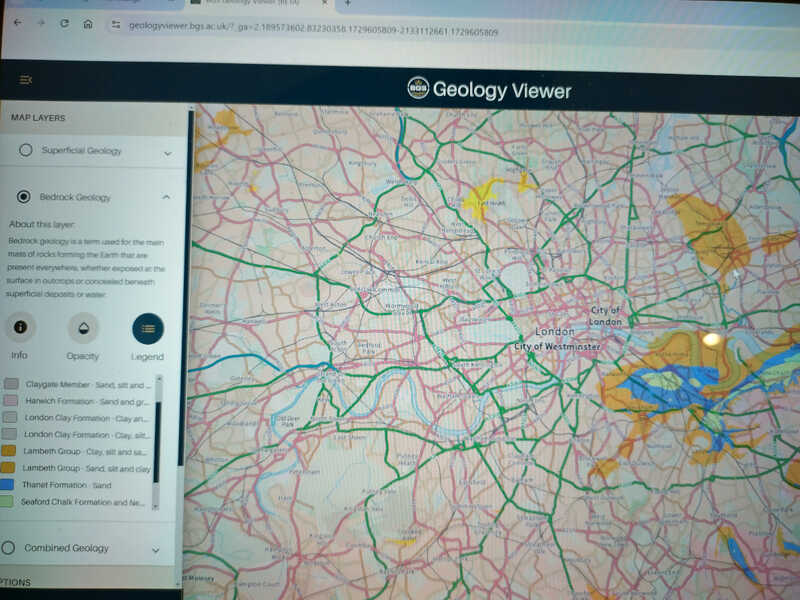
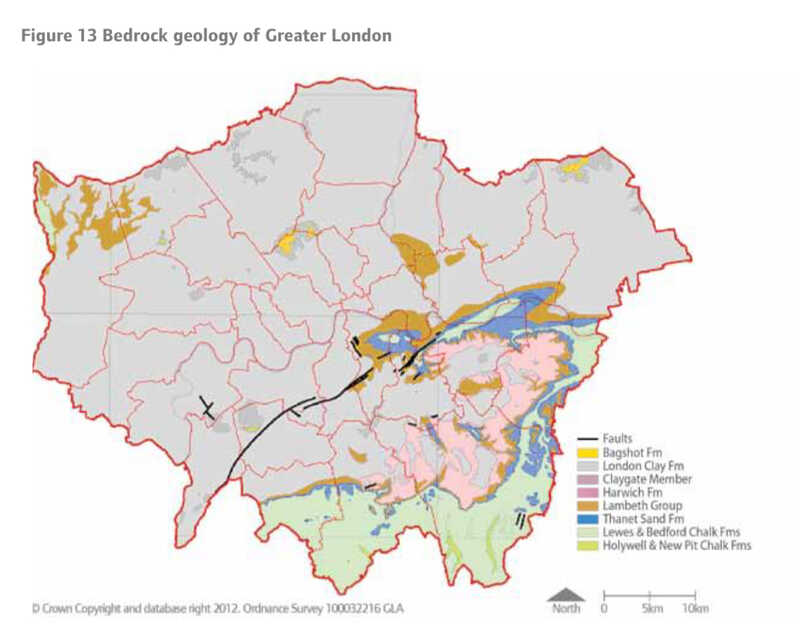
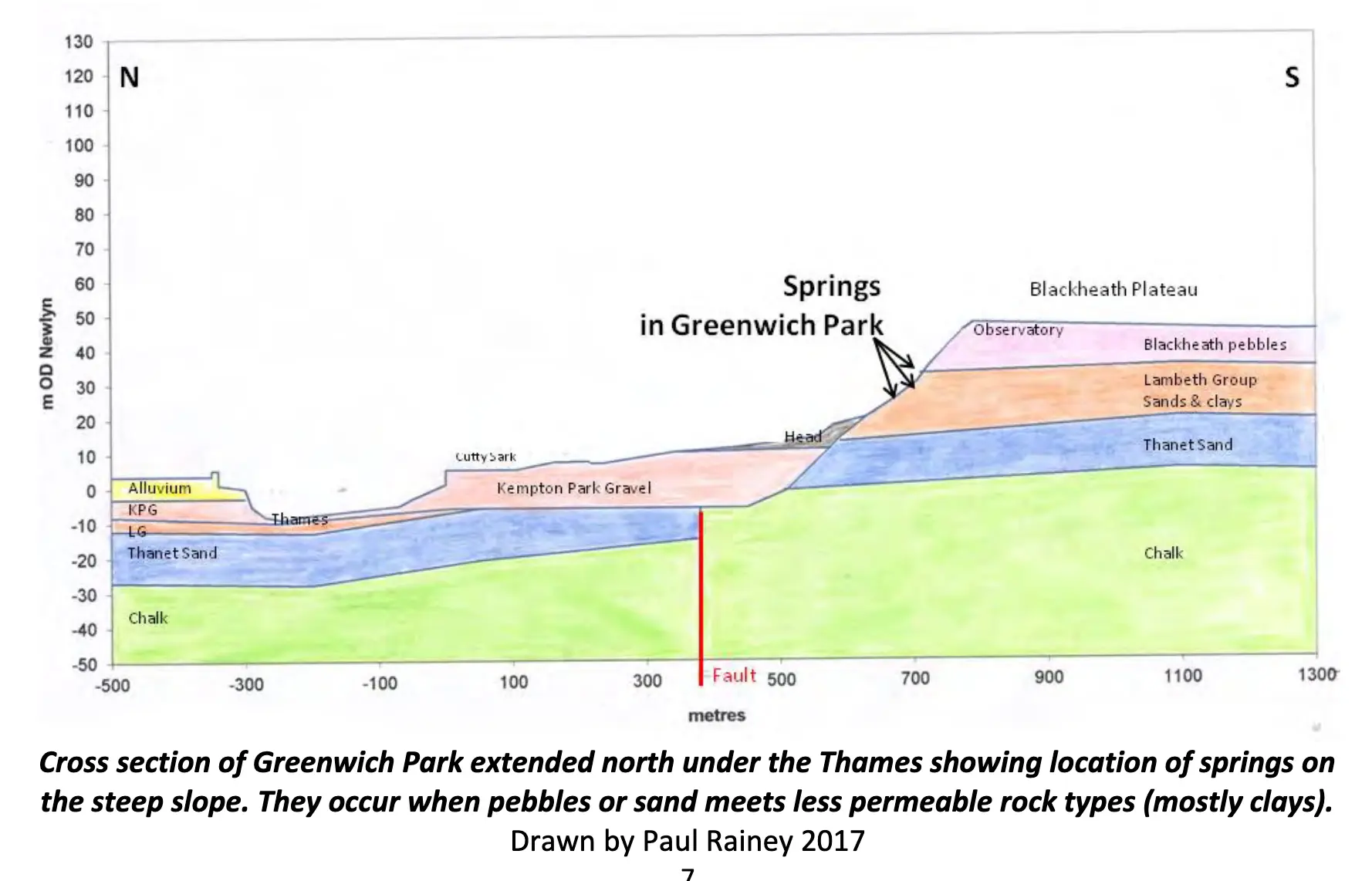
The soil though which the tunnel was dug was extremely unstable; described as, ”silty
clay with locally developed beds of fine to coarse grained sand mainly less than 1m thick
but locally up to 4m thick”
The pedestrian tunnel was one of the earliest tunnels under the Thames. Dug through
formations lying above the easily worked London clay, the difficulties in tunneling may
well have warned the London Underground engineers to subsequently stay clear of
South London, concentrating on underground railways in the easier London Clay north
of the river.
There is a display board outside the foot tunnel which gives the history of the tunnel and some
geological information. Unfortunately, it contains a number of misleading statements relevant to
the geology. Although it states that the tunnel was dug through chalk, it appears mainly to have
been cut in the very variable sands and clays of the Lambeth Group and perhaps partly in Thanet
Sand. It was excavated by hand but under compressed air. The top of the Chalk in the tunnel area is
at about 33m below sea level (14m below the base of the tunnel).
The tunnelling work was divided into eight sections. Between Tooting Broadway and Colliers Wood the tunnels were divided in order to facilitate operations between the former station and Trevelyan Road, where the ground was water-logged and the work had to proceed by the aid of compressed air. There was also a cut-and-cover section (reinforced concrete tunnels) at Merton. This unusual practice was necessitated because of the water-logged state of the ground.
"Difficulty has been experienced in the construction of the new station of Tooting Broadway on the Morden extension of the Underground. The soil consists of an upper deposit of blue clay, below which are Woolwich beds (sandy clay) and extensive pockets of waterlogged sand. The Woolwich beds, which are at a higher level than is usual in the London are composed of a layer of shell and clay, hardened into a sort of natural concrete."
Whilst the London Clay Formation has long been known as a consistent and
reliable tunnelling and excavation medium, at least within the bounds of traditional techniques,
this could not be said of the Lambeth Group.